
Oriental Cat
Oriental Cats captivate with their striking looks and enigmatic personalities, standing out as one of the most distinctive feline breeds in the world. With their sleek bodies, angular faces, and extraordinarily expressive eyes, these elegant creatures command attention wherever they go.
Unlike many other breeds, Oriental cat temperament combines extreme devotion with impressive intelligence. These felines form intense bonds with their humans, often following them from room to room like loyal shadows. Moreover, the Oriental cat breed comes in an astonishing variety—over 300 coat color and pattern combinations exist between Oriental shorthair and Oriental longhair varieties. Their personality traits are equally diverse, ranging from playful acrobats to talkative companions who engage in lengthy “conversations” with their owners.
This comprehensive guide explores the hidden qualities that make Oriental cats truly special, from their distinctive physical characteristics to their quirky behavioral traits. Whether you’re considering bringing one home or simply fascinated by these remarkable felines, you’ll discover what truly sets them apart from other breeds.
The Oriental Cat at a Glance
Behind every elegant Oriental cat lies a fascinating history and a distinct set of physical characteristics that make this breed truly special. Let’s delve into the essential aspects that define these remarkable felines.
Breed origin and classification
The Oriental cat’s journey began in the post-World War II era when cat populations had declined dramatically. Initially developed in the United Kingdom during the 1950s, breeders sought to expand the Siamese coat color range while maintaining their distinctive body type . They achieved this through selective crossbreeding of Siamese cats with Russian Blues, British Shorthairs, Abyssinians, and domestic shorthairs .
Though the breed’s genetic roots ultimately trace back to Thailand, the formal development of the Oriental Shorthair we know today took place in the United States. A group of New York area cat breeders, led by Vicky and Peter Markstein of PetMark cattery, spearheaded this effort in the early 1970s . Their interest was sparked by lynx-patterned and solid-colored cats with Siamese body types at other catteries.
Consequently, the Oriental Shorthairs International was formed in 1973, and Peter Markstein presented the breed to the Annual Cat Fanciers’ Association in 1976 . The breed received official recognition for championship competition in 1977, with the Oriental Longhair variety later added to the breed registration in 1995 .
Common nicknames and aliases
Due to their extraordinary variety of coat patterns and colors, Orientals have earned the fitting nickname “Rainbow Cat” . This term perfectly captures the breed’s remarkable diversity, with over 300 color and pattern combinations available across both shorthair and longhair varieties .
Additionally, some cat enthusiasts refer to them as the “Ornamental” or “Honking cat” due to their distinctive vocalizations . Within certain breeding circles, particularly in the UK, you might hear them called “Velvet Ninja,” “Chatty Royal,” or “British Burmese Cousin” , nicknames that highlight their sleek appearance and vocal nature.
Basic stats: size, weight, lifespan
Oriental cats feature a medium-sized, sleek body with long lines and a muscular build . Regarding height, they typically stand between 9-11 inches (23-28 cm) tall , while their body length ranges from 11-14 inches (28-36 cm) to 18-22 inches (45-56 cm) depending on the individual cat .
Weight distribution shows noticeable differences between genders. Male Orientals generally weigh between 7-12 pounds (3.6-5.4 kg), while females are typically lighter at 5-10 pounds (2.7-4.5 kg) . This lean build contributes to their athletic ability and graceful movements.
Furthermore, Oriental cats are blessed with good longevity. Their average lifespan ranges from 12-15 years , though with proper care, some can live even longer. This relatively long life expectancy makes them wonderful companions for extended periods.
When it comes to pricing, prospective owners should be prepared for a significant investment. Oriental kittens from reputable breeders can cost between ₹50,628 to ₹126,570 ($600-$1,500) depending on pedigree, age, and location .
The Oriental cat’s classification varies somewhat between registries. The breed holds championship status with the Cat Fanciers’ Association (CFA) , while other organizations like TICA initially classified them as an “Advanced New Breed” before incorporating them into a broader Asian Group .
Unique Physical Features
From first glance, the Oriental cat makes an unmistakable impression with striking features that set this breed apart from all others. Indeed, these felines possess some of the most distinctive physical characteristics in the feline world.
Angular face and large ears
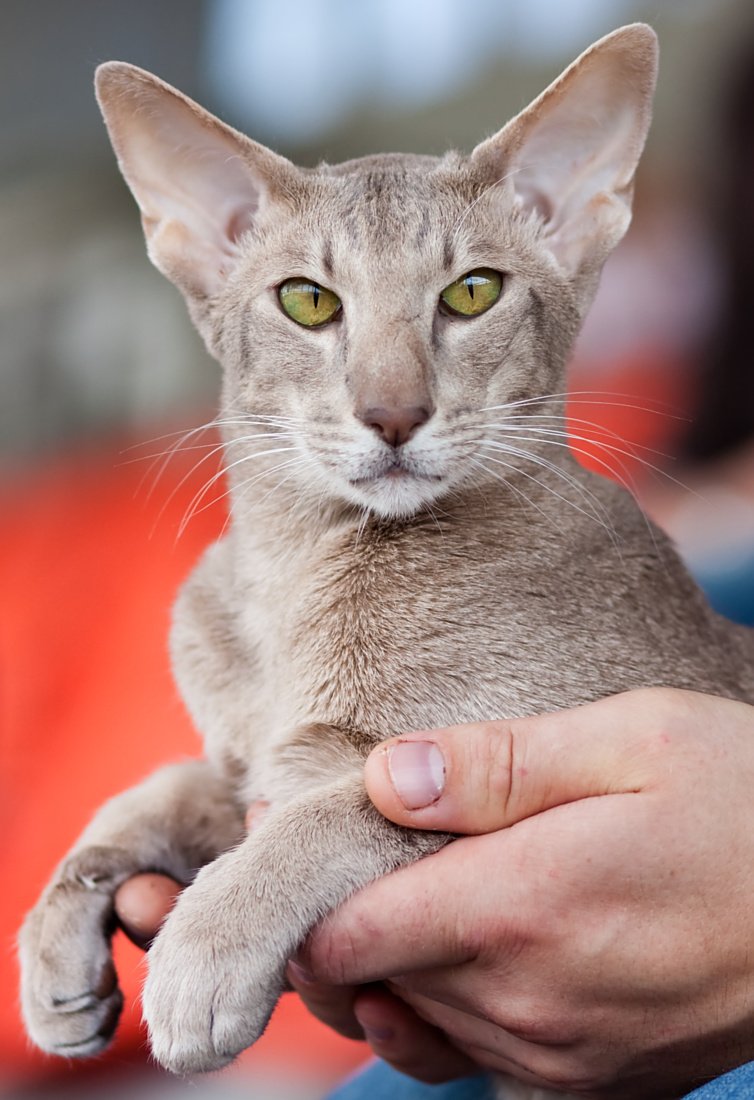
The Oriental cat’s head forms a perfect long, tapering wedge that creates an unforgettable profile. This distinctive triangular shape starts at the nose and flares out in straight lines to the ear tips without any break at the whiskers . When viewed from the front, this creates an equilateral triangle that narrows in perfectly straight lines to a fine muzzle .
Their ears are perhaps their most dramatic feature—strikingly large, pointed, and wide at the base . These prominent ears continue the lines of the wedge shape, sitting high on the head and giving them an alert, regal appearance . In fact, some compare these distinctive ears to those of a Chihuahua or even Dobby from the Harry Potter series .
The Oriental’s eyes complete their exotic look—almond-shaped, medium-sized, and set at a slight angle that harmonizes with the lines of their wedge-shaped face . This eye positioning slants toward the nose, creating a mysterious, almost mesmeric gaze that cat lovers find irresistible.
Their long, straight nose creates a streamlined profile , while a strong chin balances their facial proportions. This angular face sits atop a long, slender neck that enhances their elegant appearance.
300+ coat color and pattern variations
One of the Oriental cat’s most remarkable traits is the extraordinary diversity in coat colors and patterns. Specifically, the breed comes in over 300 different color and pattern combinations , earning them the nickname “Rainbow Cat” .
The basic coat types include:
- Solid colors: Uniform color from root to tip, including black, blue, havana (brown), lilac, cinnamon, fawn, red, cream, white, and others
- Shaded: White, ivory to pale honey or apricot undercoat, with colored tipping that appears solid when still but reveals the pale undercoat when moving
- Smoke: Appears solid when at rest but reveals a narrow white band at the hair base when in motion
- Parti-colors: Solid base with patches of red or cream, either well-defined or softly intermingled
- Bi-colors: Combines any coat pattern with white on feet, legs, underside, chest, and muzzle, including an inverted “V” on the face
- Tabby patterns: Available in classic, mackerel, spotted, and ticked varieties
- Pointed: Similar to Siamese coloration with darker extremities
This incredible variety stems from their development history. Originally bred from Siamese cats (which have limited colors), Oriental breeders purposefully expanded the palette through strategic crossbreeding .
Eye color diversity and meaning
The Oriental’s eyes offer another layer of fascinating variation, with eye color directly tied to coat color in meaningful ways. According to breed standards, the typical Oriental should have bright green eyes . This vibrant green eye color makes a striking contrast with their coat colors and is highly valued in show-quality cats.
Nevertheless, eye color inheritance appears somewhat mysterious. As one Oriental cat association notes, there seems to be no logic to green eye inheritance—parents with perfect eye color can produce kittens with poor eye color, while yellow-eyed parents sometimes produce kittens with perfect green eyes .
Besides the standard green, other eye colors are permissible based on coat type. Pointed Orientals (those with Siamese-style coloring) must have blue eyes . White Orientals and bi-colored cats may have blue, green, or odd eyes (one of each color) . The Foreign White, essentially a white-coated Siamese genetically, retains the royal blue eyes of its Siamese ancestry .
Eye color plays a crucial role in competitive showing. As noted by breed experts, good eye color can make the difference between a “top winner” and an “also ran” . Judges evaluate eye color intensity and clarity, with “clear, bright vivid green” specified for certain varieties like Havana and Lilac Orientals .
Personality Traits That Set Them Apart
Beyond their striking physical appearance, the Oriental cat’s personality truly makes them extraordinary companions. These felines possess distinctive behavioral traits that create deep, meaningful connections with their human families.
Affectionate and loyal
Despite their regal and sometimes aloof appearance, Oriental cats are extraordinarily affectionate companions who form intense bonds with their owners. They’re frequently described as having “dog-like” loyalty, often becoming particularly attached to one specific person in the household . This devoted nature means they’ll seek out their favorite humans for cuddles and attention throughout the day.
Oriental cats are remarkably affectionate lap cats who enjoy sleeping next to their owners in bed . Their elegance might suggest standoffishness, yet the reality couldn’t be more different—these cats crave physical closeness and emotional connection. Many owners report their Orientals becoming visibly depressed if they don’t receive enough quality time and attention .
Remarkably, this devotion extends beyond casual affection. Oriental cats form strong emotional bonds that make them exceptionally sensitive to their owner’s moods and feelings . They’ll often offer comfort during difficult times, demonstrating an almost intuitive understanding of human emotions.
Highly vocal and expressive
Certainly, one of the most distinctive personality traits of the Oriental breed is their extraordinary vocalization. These cats are natural conversationalists who communicate through a wide range of sounds—from soft chirps and trills to loud, insistent meows . Many owners describe having full “conversations” with their Oriental cats who respond with various vocalizations when spoken to .
The Oriental’s vocal repertoire includes a distinctive “honk” that resembles the sound geese make, earning them the nickname “honking cat” . They use these unique sounds to express excitement, interest, despair, and various other emotions . Unlike more reserved breeds, Orientals aren’t shy about letting their opinions be known—they’ll vocalize when they want something, when they’re curious about what you’re doing, or simply to check where you are .
Their expressive nature extends beyond vocalization. Oriental cats communicate through distinctive facial expressions, body language, and direct eye contact . Owners often report being able to “read” their Oriental’s mood easily through these visual cues.
Social and people-oriented
Oriental cats are exceptionally social creatures who thrive on human interaction. Unlike more independent breeds, they actively seek engagement with their families and frequently follow their owners from room to room throughout the house . This “velcro kitty” behavior demonstrates their strong desire to be involved in all aspects of their owner’s life .
This social nature makes them ideal companions for households with multiple pets or children. They typically get along well with dogs and other cats, especially when properly socialized from kittenhood . Their playful, energetic temperament remains kitten-like well into adulthood, making them entertaining and engaging family members .
Significantly, the Oriental’s need for companionship means they don’t fare well when left alone for extended periods . They can become withdrawn, anxious, or even depressed without adequate social interaction . For this reason, many breeders and veterinarians recommend having multiple pets if an Oriental will be alone frequently .
Their intelligence compounds their social nature—Orientals can learn tricks, solve puzzles, and even walk on leashes . This mental acuity means they require regular stimulation and engagement to prevent boredom and resulting behavioral issues .
Hidden Behavioral Quirks
Beneath the social surface of Oriental cats lie fascinating behavioral quirks that create uniquely intense human-cat relationships. While many cats maintain an air of independence, the Oriental breed exhibits distinctive attachment patterns that set them apart from their feline cousins.
Attachment to one person
Unlike typical cats who may distribute affection evenly, the Oriental cat frequently forms an exceptional bond with a single household member. This people-oriented breed typically establishes a close relationship with one specific person , creating a partnership that goes beyond casual pet ownership. This attachment manifests as remarkable loyalty toward their chosen human companion.
Notably, once an Oriental selects their favorite person, they demonstrate extraordinary devotion. As highlighted by breed experts, those who receive an Oriental’s special affection find their cat will do practically anything to please them . This singular attachment often surprises new owners who might expect more typical feline aloofness.
Some Oriental cats take this attachment to extraordinary levels. As one owner reports, her Oriental was “stuck on him like Krazy glue and wailed if he didn’t hold her and rock her” . This intensity of connection resembles what researchers identify as “secure attachment” – a relationship pattern similar to those formed by human infants and dogs. In fact, a groundbreaking Oregon State University study (2019) found over 64% of cats exhibit this secure attachment style .
Tendency to follow owners around
One of the most distinctive Oriental cat behaviors is their persistent shadowing of their humans. They routinely follow their owners from room to room throughout the house, maintaining a constant presence . This behavior has earned them a reputation for being exceptionally clingy companions .
Surprisingly, this following behavior serves multiple purposes for Oriental cats. Primarily, it represents their deep desire to participate in family activities and remain involved in their owner’s life . As one observer notes, their “inquisitive nature means that he’ll go to great lengths to be involved in your activities” .
Meanwhile, this following behavior often comes with a soundtrack—Orientals typically “chat” as they trail behind, offering running commentary on everything happening around them . This combination of physical presence and vocal expression creates a unique form of feline companionship rarely seen in other breeds.
Furthermore, many owners find their Oriental’s following habit endearing rather than annoying. As one breed profile observes, “You’ll never be lonely with this breed” , highlighting how this behavior creates a constant feeling of companionship for owners.
Sensitivity to being left alone
Perhaps the most significant hidden quirk of Oriental cats is their pronounced sensitivity to solitude. They actively dislike being left alone for extended periods and can develop genuine emotional distress when separated from their humans.
For instance, if an Oriental wakes up alone in a room, they may “cry and cry until picked up and snuggled” . This sensitivity can manifest as full-fledged separation anxiety, characterized by several observable symptoms:
- Excessive vocalization when you leave or prepare to leave
- Destructive behavior like scratching doors or furniture
- Inappropriate elimination, particularly near owner belongings
- Over-grooming or fur pulling
- Refusing to eat or drink when left alone
To clarify, this sensitivity stems from their deeply social nature rather than a behavioral problem. Oriental cats can become genuinely “withdrawn and depressed when left alone for more than a few hours at a time” . For this reason, experts typically recommend getting another Oriental cat if you’re out at work all day .
Oriental cats are particularly reactive to changes in household routine, relocations, new people or pets, and environmental stressors . During such transitions, their following behavior often intensifies as they seek reassurance from their human—the only constant in their environment.
Intelligence and Trainability
The remarkable intelligence of Oriental cats distinguishes them as extraordinary learners in the feline world. These highly cognitive creatures possess not only striking looks and affectionate personalities but also an exceptional capacity for training that surprises many first-time owners.
Learning tricks and commands
Oriental cats demonstrate outstanding aptitude for learning new skills and commands. Their sharp minds and problem-solving abilities make them ideal candidates for trick training . With consistent positive reinforcement techniques—treats, praise, and interactive play—these cats readily master basic commands like “sit,” “come,” and even more complex tricks .
Short, engaging training sessions yield the best results as Oriental cats can become bored with repetitive activities . Clicker training proves particularly effective with this breed, allowing owners to precisely mark desired behaviors . Throughout, the emotional bond between cat and human enhances learning; Oriental cats respond exceptionally well to calm, encouraging tones from their owners .
What makes Oriental cats unique is their eager participation in interactive training. Unlike many felines who might ignore attempts at training, Orientals actively engage with their human companions in these learning experiences . This doesn’t mean they’ll perform on command like dogs—they maintain their independent nature and follow their own desires —yet they consistently demonstrate impressive learning capabilities.
Using puzzle toys and feeders
Puzzle feeders offer an excellent outlet for the Oriental cat’s natural intelligence. These devices hold food or treats that cats must manipulate to access , providing mental stimulation that prevents boredom and related behavioral issues .
Puzzle feeders come in various forms:
- Mobile puzzles (balls, tubes, eggs with holes)
- Stationary puzzles (bases with holes, cups, or channels)
- DIY options (modified plastic bottles with small holes)
These enrichment tools provide substantial benefits for Oriental cats. Studies show that cats using puzzle feeders are happier, more physically fit, and exhibit fewer behavioral problems such as aggression and over-grooming . Additionally, puzzle feeders encourage slower eating, potentially reducing obesity .
Importantly, puzzle feeders tap into the Oriental cat’s predatory instincts by simulating hunting behaviors . This mental engagement can significantly reduce stress and anxiety—crucial for a breed known to be sensitive when left alone . As such, setting up puzzle feeders before leaving for work provides stimulating activities for your Oriental while you’re away .
Walking on a leash
Among their most impressive trainable skills, Oriental cats can learn to walk on a leash . This ability allows these indoor felines to safely experience outdoor enrichment while remaining secure .
Leash training requires patience and follows several key stages:
- Harness acclimation—letting your Oriental cat get comfortable wearing the harness indoors
- Introducing the leash with positive associations
- Indoor practice with the leash before venturing outside
- Gradually transitioning to outdoor environments
Oriental cats typically adapt well to harness training, although younger cats often accept it more readily . The process can take anywhere from a few days for kittens to 3-4 weeks for adult cats . Throughout training, positive reinforcement and clicker training significantly enhance learning .
The leash walking experience differs from dogs—Oriental cats prefer to explore at their own pace rather than walking structured routes . This activity provides both mental and physical stimulation, especially valuable for this active, intelligent breed .
By investing time in training your Oriental cat through these various methods, you’ll strengthen your bond while providing essential mental stimulation that satisfies their innate intelligence and curiosity.
Health Considerations for Oriental Cats
While Oriental cats possess many desirable traits, they face several breed-specific health challenges that prospective and current owners should understand. Knowing these conditions can help ensure your feline friend receives proper care throughout their life.
Amyloidosis and organ risks
Oriental cats have a genetic predisposition to amyloidosis, a serious condition where proteins called amyloid deposit outside cells in various tissues and organs. Unlike other cat breeds where this condition typically develops later in life, Oriental cats may develop amyloidosis as early as 1-4 years of age . This genetic vulnerability particularly affects Siamese, Burmese, Tonkinese, Devon Rex, and Oriental shorthair breeds .
The disease primarily affects vital organs, causing significant disruption to their function. In Oriental cats, amyloidosis predominantly impacts the liver and thyroid gland , whereas in other breeds like Abyssinians, the kidneys are more commonly affected. The liver manifestation can be particularly dangerous as it may lead to organ enlargement, fragility, rupture, and internal bleeding .
Clinical signs of amyloidosis include weight loss, mouth ulcers, continual vomiting, dehydration, and ultimately kidney or liver failure . Unfortunately, once a cat starts showing symptoms, the disease is often already in advanced stages. Most cats with kidney involvement survive less than one year after diagnosis , highlighting the importance of regular veterinary checkups.
Progressive retinal atrophy (PRA)
Progressive retinal atrophy represents another genetic concern for Oriental cats. This condition involves the gradual deterioration of the retina’s photoreceptors (rods and cones), leading to progressive vision loss . Oriental cats typically develop late-onset PRA, with symptoms becoming detectable around 1-2 years of age through professional eye examination .
Initially, PRA affects night vision, making cats appear disoriented in dim lighting. As the condition progresses, affected Orientals may bump into objects, struggle to find food and water bowls, become withdrawn at night, show reluctance to navigate stairs, and exhibit dilated pupils . Complete blindness typically develops by 3-5 years of age, although progression varies between individuals .
Fortunately, genetic testing has become available for PRA in Oriental cats. The mutation called rdAc in the CEP290 gene has been identified as the culprit . Responsible breeders now use these tests to reduce the prevalence of PRA in breeding programs. Cats carrying a single copy of the gene (carriers) can still be used for breeding if paired with cats free of the mutation, thus preserving important bloodlines while preventing affected offspring .
Pica and behavioral health
Pica—the compulsion to eat non-nutritive items—occurs with notable frequency in Oriental cats. This unusual behavior involves chewing, sucking, or consuming inappropriate materials like fabric, plastic, paper, cardboard, rubber, and plants . One UK study revealed Oriental cats were significantly over-represented for this condition, with wool being the preferred item .
The causes of pica remain incompletely understood but appear multifactorial. Genetic predisposition plays a significant role, alongside factors such as early weaning, anxiety, boredom, and redirected hunting behavior . Various medical conditions may also trigger pica, including anemia, gastrointestinal disorders, endocrine diseases, and nutritional deficiencies .
Beyond being simply odd behavior, pica poses genuine health risks. Ingested objects can cause gastrointestinal blockages, potentially requiring emergency surgery. Furthermore, pica can damage the human-animal bond due to destroyed belongings and may even lead to relinquishment or euthanasia in severe cases .
Management strategies include providing environmental enrichment, addressing underlying medical conditions, maintaining regular feeding schedules, and in some cases, medication for anxiety or compulsive disorders . Puzzle feeders and interactive toys can help satisfy the Oriental cat’s need for mental stimulation and reduce boredom-related pica behaviors.
Grooming and Maintenance Needs
One significant advantage of welcoming an Oriental cat into your home is their straightforward grooming requirements. These elegant felines offer a perfect balance of beauty and practicality when it comes to maintenance needs.
Low-maintenance coat care
The Oriental cat’s sleek, fine coat stands as one of their most practical features. Unlike many breeds requiring extensive grooming routines, these cats possess silky, short hair that needs minimal attention . Their coat lies close to the body and notably lacks an undercoat, which substantially reduces matting risks .
Most Oriental cats maintain their coat condition with just weekly brushing using a soft-bristle brush or grooming mitt . Some owners find that even brushing a couple of times monthly suffices . This minimal grooming routine helps distribute natural oils throughout their skin and fur, enhancing their naturally glossy appearance .
Beyond practical maintenance, grooming sessions with Oriental cats serve a deeper purpose. For these attention-loving felines, grooming becomes a cherished bonding experience where they enjoy your undivided attention . Many owners report that these one-on-one grooming moments become equally rewarding for both cat and human.
Ear and dental hygiene
The Oriental’s distinctive large, almost bat-like ears require specific attention. These prominent features skillfully pivot to detect sounds from surprising distances and can perceive frequencies beyond human hearing range . However, their size makes them prone to collecting dirt and debris .
Proper ear care involves weekly checks for signs of dirt, wax buildup, or potential infection indicators like redness, odor, or discharge . Clean their ears gently using a damp cotton ball or soft cloth moistened with vet-approved cleaner . Importantly, never insert anything like Q-tips into the ear canal as this could damage their delicate ears .
Dental hygiene proves equally crucial as Oriental cats have predisposition to dental issues including gingivitis and periodontal disease . Veterinary experts recommend brushing their teeth several times weekly using cat-specific toothpaste and toothbrushes . Supplementing this routine with dental treats and toys designed to reduce plaque buildup offers additional protection .
Managing shedding
Oriental cats typically shed less than many other breeds thanks to their single-layer coat structure . Nonetheless, they do shed lightly year-round, with some increase during seasonal changes in spring and fall .
Managing loose fur requires consistent but minimal effort. Using appropriate tools like soft-bristled brushes or grooming gloves once weekly effectively controls shedding . During seasonal shedding periods, increasing brushing frequency to twice weekly helps manage loose fur before it lands on furniture .
Diet significantly impacts coat health and shedding patterns. Oriental cats maintain healthier coats and shed less when fed protein-rich, high-moisture diets containing omega-3 and omega-6 fatty acids . Their ideal diet should consist of approximately 50% protein and at least 20% fat, with minimal carbohydrates .
For homes with allergy sufferers, wiping down your Oriental cat twice weekly with a damp cloth can substantially reduce airborne allergens . Additionally, regular vacuuming with HEPA filters helps control any fur that escapes your grooming routine.
Feeding and Nutrition Tips
Proper nutrition forms the foundation of health for the active and lean Oriental cat breed. Understanding their specific dietary needs helps maintain their signature slender physique while supporting overall wellbeing.
Portion control for lean build
Oriental cats naturally possess sleek, muscular bodies that require careful portion management. These active felines have faster metabolisms than many other breeds , yet they’re prone to weight gain if overfed . Most Oriental cats require approximately 200 calories per 24 hours , typically equivalent to one tuna-sized can of wet food daily.
For precise portion control, use a food measuring scale and adjust quantities based on your cat’s age, activity level, and overall health . Growing Oriental kittens need more frequent feeding—3 to 4 small meals daily —while adults benefit from controlled portion sizes served at scheduled times.
Avoiding free feeding
Free feeding (leaving food available all day) is strongly discouraged for Oriental cats . Instead, establish regular meal times with measured portions . This scheduled approach helps prevent obesity, maintains their characteristic lean shape , and supports better weight management.
If your work schedule makes regular feeding difficult, consider puzzle feeders as an alternative . These devices provide mental stimulation while slowing eating speed . Studies show cats using puzzle feeders are happier, more physically fit, and exhibit fewer behavioral problems .
Best food types for Orientals
As obligate carnivores, Oriental cats require diets high in animal protein . Their food should feature high-quality protein sources like chicken, turkey, or fish listed as the first ingredient . Look for products meeting Association of American Feed Control Officials (AAFCO) nutritional guidelines .
A combination of wet and dry food offers ideal nutrition . Wet food helps with hydration—especially important since many cats don’t drink enough water naturally . For eye health, choose foods containing vitamin E and zinc , while B vitamins support liver function .
Always provide fresh water and consider specialized formulas for different life stages—growth formulas for kittens and maintenance diets for adults .
Conclusion
Oriental cats truly stand as one of the most extraordinary feline companions available to cat enthusiasts today. Their striking wedge-shaped faces, oversized ears, and remarkable variety of coat colors make them visually unforgettable, while their personalities offer equally distinctive traits that create deep bonds with their human families.
These elegant felines combine intelligence with affection in ways few other breeds manage. Their exceptional capacity for learning tricks, using puzzle feeders, and even walking on leashes demonstrates cognitive abilities that surprise many first-time owners. Additionally, their deeply loyal nature creates relationships more reminiscent of dogs than typical cats, though they maintain their feline independence and dignity throughout.
Prospective Oriental cat owners should certainly consider several important factors before bringing one home. First, these social creatures require significant attention and companionship—they genuinely suffer when left alone for extended periods. Second, awareness of breed-specific health concerns like amyloidosis and progressive retinal atrophy enables proper preventative care. Finally, understanding their nutritional needs helps maintain their characteristic sleek physique.
The Oriental’s minimal grooming requirements balance nicely against their need for mental stimulation and emotional engagement. Weekly brushing sessions, regular dental care, and appropriate ear cleaning provide sufficient physical maintenance for these naturally clean cats.
Ultimately, Oriental cats reward their owners with extraordinary devotion, engaging conversations, and constant companionship. Their unique combination of exotic beauty, playful intelligence, and heartfelt affection makes them perfect for families seeking an interactive, deeply bonded feline relationship rather than a traditional, independent cat. Though they demand more emotional investment than many breeds, Oriental cats return that investment tenfold through their lifelong loyalty and distinctive personality.